1

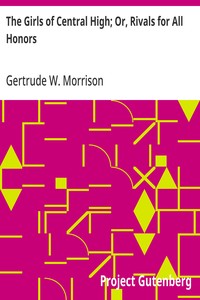
The Girls of Central High on Track and Field Or, The Champions of the School League — Background and Themes
(0 User reviews)
64
Project Gutenberg
2010
Not confirmed
Schools -- Juvenile fiction; High school students -- Juvenile fiction; Mystery and detective stories; Romanies -- Juvenile fiction; Competition -- Juvenile fiction; Track and field for women -- Juvenile fiction
Readers of public-domain and historical texts
Project Gutenberg digital edition
en
Edition facts
Words
43,358
Reading time
189 min
Text sections
29
For The Girls of Central High on Track and Field Or, The Champions of the School League — Background and Themes, the stored edition analysis reports 43,358 words, 3 hr 9 min estimated reading time, and 29 detected text sections.
The text analysis averages about 13.3 words per sentence, while the detected sections provide another way to judge how the source is divided.
Project Gutenberg metadata also associates the work with “Schools -- Juvenile fiction,” connecting these edition facts with the source record’s subject description.
Source:
Project Gutenberg record #34749
This editorial note examines the narrative voice and pacing in Gertrude W. Morrison's school story, focusing on the contrast between athletic competition and a Gypsy mystery subplot, with observations on dialogue, descriptive rhythm, and structural shifts.
Read the complete public-domain text at its original source.
Read on Project GutenbergThe opening chapter of The Girls of Central High on Track and Field establishes a brisk, colloquial narrative voice through dialogue and physical description. Clara “Bobby” Hargrew is introduced as a “black-eyed, be-curled, laughing miss” whose energy is contrasted with the weariness of her friend Jess Morse. The narrator uses direct speech to convey character: Bobby’s retort about conserving her energies mimics the school’s teacher, “Gee Gee,” while her friend’s comment that she is “next door to perpetual motion” is met with a playful pun. This early interplay sets a tone of lighthearted camaraderie, but the prose also shifts into more detailed, sensory description of the spring landscape, creating a rhythm that alternates between brisk dialogue and slower, scenic passages.
Voice and Characterization Through Dialogue
The narrative voice relies heavily on dialogue to define character and advance the plot. Bobby’s speech is peppered with exclamations and direct challenges, as when she tells a senior, “You make me tired!” in response to a taunt about the quarter-mile race. This bluntness is consistent with her portrayal as energetic and competitive. In contrast, Eve Sitz is given more measured lines, often expressing concern or uncertainty, as when she wakes Bobby with “Oh, Bobby! Bobby! Wake up—do! What do you suppose has happened?” The narrator also uses indirect speech to summarize group reactions, such as when Laura Belding “declared” that Eve would not interfere with other athletes. These variations in dialogue create distinct voices for the main characters without relying on extensive internal monologue.
Pacing and Descriptive Rhythm
The pacing shifts noticeably between the athletic training scenes and the mystery involving the Gypsy girl, Margit Salgo. The track-and-field passages are brisk, with short sentences and action verbs: “Bobby won by a clean two yards” (from the illustration caption). In contrast, the kidnapping episode slows to a deliberate, suspenseful rhythm. The description of the morning after Margit’s disappearance uses careful detail: “The window sash was up and the blinds wide open,” and “several planks had been laid upon the soft earth, to make a walk to the hard path.” This attention to physical evidence creates a detective-like pause in the narrative, contrasting with the forward momentum of the sports chapters. The alternation between these two modes gives the book a varied tempo, though the excerpts do not reveal how the subplot ultimately integrates with the athletic climax.
Structural Juxtaposition of Subplots
The book interleaves two distinct storylines: the school’s track-and-field competition and the mysterious reappearance of the Gypsy girl. Chapter titles such as “The Gypsy Camp” and “The Gypsy Queen” indicate a sustained subplot, while chapters like “The Races” and “Inter-Class Rivalry” signal the sports focus. The narrative voice treats both strands with similar seriousness—Bobby’s concern for Margit is voiced with the same directness as her athletic ambitions. However, the excerpts show that the mystery subplot relies on external action (a kidnapping, a wagon track) rather than internal character development. The structural juxtaposition suggests that the book aims to balance school-story conventions with adventure, but the excerpts are incomplete regarding how these threads resolve or whether the pacing remains consistent throughout.
Readers attentive to narrative voice will notice how Morrison uses dialogue to differentiate characters and how she varies sentence length to control pace. The mystery subplot introduces a slower, more observational style that contrasts with the energetic sports scenes. Pay attention to how the narrator handles transitions between these modes—whether through chapter breaks or within scenes—and how the voices of Bobby, Eve, and others shift when the plot turns from competition to investigation.
Reading about the Gypsy subplot in The Girls of Central High brought me back to the hushed library corner where I first met the quiet outsider in Miss Ashton's New Pupil: A School Girl's Story — Inside the Classic. Both books hide a softer loneliness beneath their schoolyard bustle, a feeling I hadn't named until now.
There are no reviews for this eBook.
There are no comments for this eBook.
Reader reflection
Before you leave, reflect on the book
Use these questions to collect your thoughts before moving on.
Your progress
0
/
10
2
How did the book work for you overall?
3
Would you encourage someone else to read it?
4
What was the reading difficulty like?
5
How well did it match your expectations?
6
Would a second reading be valuable?
7
How closely did the book connect with your experience?
8
How valuable was this book for your own interests?
9
What is the main idea you are taking away?
10