1

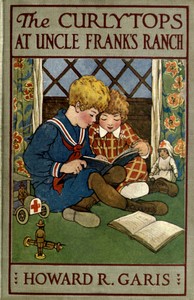
The Curlytops at Uncle Frank's Ranch; Or, Little Folks on Ponyback — Text and Context
(0 User reviews)
34
Project Gutenberg
2010
Not confirmed
Siblings -- Juvenile fiction; Ranches -- Juvenile fiction; Ranch life -- Juvenile fiction; West (U.S.) -- Juvenile fiction; Families -- Juvenile fiction; Cowboys -- Juvenile fiction
Readers of public-domain and historical texts
Project Gutenberg digital edition
en
Edition facts
Words
48,937
Reading time
213 min
Text sections
5
The source record for The Curlytops at Uncle Frank's Ranch; Or, Little Folks on Ponyback — Text and Context measures this digital text at 48,937 words, 3 hr 33 min estimated reading time, and 5 detected text sections.
The text analysis averages about 12.1 words per sentence, while the detected sections provide another way to judge how the source is divided.
Project Gutenberg metadata also associates the work with “Siblings -- Juvenile fiction,” connecting these edition facts with the source record’s subject description.
Source:
Project Gutenberg record #32525
This editorial note examines Howard R. Garis's diction, dialogue, and descriptive choices in The Curlytops at Uncle Frank's Ranch, focusing on how the author constructs child characters through their speech and play, and how the Western setting is filtered through a child's perspective.
Read the complete public-domain text at its original source.
Read on Project GutenbergHoward R. Garis opens The Curlytops at Uncle Frank's Ranch not with a landscape or a journey, but with a quarrel over play. Teddy Martin, wearing his father's oversized coat and spectacles, abruptly declares, "Say, Jan, this isn't any fun!"—a line that immediately establishes the children's voices as distinct and naturalistic. The author uses dialogue to reveal character: Teddy's impatience, Janet's practicality, and their shared inventiveness. The opening scene, in which they abandon playing doctor for cowboy games, sets up the central tension between domestic routines and the allure of Western adventure.
Diction and the Child's Voice
Garis consistently uses colloquial, period-appropriate language that sounds like real children. Teddy says "busted" instead of "broken," and Janet cries "Oh, my dear!" in imitation of her mother. The author avoids condescension; the children's misunderstandings (like Janet thinking "bread pills" are medicine) are presented with gentle humor. The dialogue is peppered with exclamations and repetitions: "Oh, I know what we can do that'll be lots of fun!" This repetition mimics the rhythm of excited speech. Garis also uses nicknames—"Curlytop" for Teddy—as a marker of affectionate familiarity within the family. The children's vocabulary is limited but expressive, relying on words like "awful" and "nice" to convey strong feelings. This lexical simplicity does not diminish the emotional weight of their interactions; rather, it makes their concerns—like whether a doll is hurt—feel genuine.
Play as a Window to Character
The excerpts show that Garis uses make-believe to reveal the children's personalities and their understanding of the adult world. Teddy wants to be a "real wild-wester" and insists on lassoing something that moves, showing his desire for authenticity within play. Janet, more cautious, negotiates the terms: "I'll fall down and get all dirt!" she protests. Their negotiation over rules—Teddy promising not to pull too hard, Janet agreeing to be a pony—mirrors real childhood bargaining. The author also uses play to introduce conflict: when Teddy lassoes a calf, Uncle Frank intervenes, demonstrating the boundary between fantasy and safety. This moment shows that Garis does not romanticize the West; instead, he filters cowboy culture through the lens of child's play, where lassoing a calf is a game with real consequences.
Descriptive Economy in Setting
Garis describes the ranch setting sparingly, often through the children's actions rather than authorial exposition. The field where Teddy practices lassoing is simply "a field not far from the house." The calf is introduced as "one of several that were kept in the stable and fed milk from a pail." These details are functional, not decorative. The author trusts the reader to infer the broader landscape from small cues: the presence of a stable, the mention of cowboys, the phrase "Ring Rosy Ranch." This economy of description keeps the focus on the children's experience. When Uncle Frank appears, he is identified only as "the ranchman," his authority established by his role rather than physical description. The setting is thus built through implication and the characters' interactions with it, not through lengthy passages of scenery.
Structure and Pacing in the Excerpts
The excerpts reveal a chapter structure that alternates between dialogue-driven scenes and brief narrative summaries. Chapter I, "Trouble's Tumble," begins in medias res with the children already playing. Garis uses short paragraphs and frequent line breaks to create a fast pace suitable for young readers. Action verbs dominate: "cried," "demanded," "teased," "ran." The author also employs a pattern of escalation: a simple game of doctor becomes cowboy play, which leads to lassoing a calf, which then attracts adult attention. This rising action is typical of the series' formula, but within the excerpts it feels organic. The chapter ends on a note of anticipation—Uncle Frank's arrival—without resolving the conflict, a technique that encourages continued reading. The pacing reflects the children's own restless energy, moving from one idea to the next without lingering.
Readers attentive to Garis's craft will notice how he balances the demands of a series formula with genuine observation of child behavior. The Curlytops are not merely vehicles for adventure; their voices, their negotiations over play, and their limited but vivid perception of the world give the story its texture. The Western setting, while exotic, remains secondary to the domestic dynamics of sibling interaction. This editorial note invites you to attend to the small, precise choices in dialogue and description that make the children feel real, even when the plot follows predictable paths.
That rainy afternoon, the Curlytops’ ponyback chatter carried me along until their ranch faded into dusk. I kept thinking how Garis lets children’s words shape their world, unbothered by adult gloss. Later, leafing elsewhere, I found the same quiet trust in a traveler’s voice, unknowingly leading me to How "a dear little couple" went abroad — Reading Notes, a gentler echo of that forgotten simplicity.
There are no reviews for this eBook.
There are no comments for this eBook.
Reader reflection
Your personal reading reflection
Build a private reading journal entry for this title.
Your progress
0
/
10
2
What was your overall reaction to the book?
3
Would you recommend this book to another reader?
4
Did the language feel accessible?
5
How useful did the reading feel?
6
Did the book deliver what you hoped for?
7
How closely did the book connect with your experience?
8
What did you appreciate most?
9
What changed or sharpened your thinking?
10