1

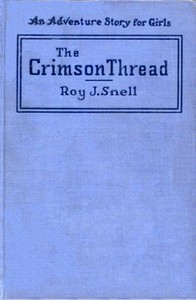
The Crimson Thread: An Adventure Story for Girls — Story, Setting & Ideas
(0 User reviews)
268
Project Gutenberg
2013
Not confirmed
Mystery and detective stories; Young women -- Social life and customs -- Juvenile fiction; Booksellers and bookselling -- Juvenile fiction; Clerks (Retail trade) -- Juvenile fiction; Department stores -- Juvenile fiction
Readers of public-domain and historical texts
Project Gutenberg digital edition
en
Edition facts
Words
53,427
Reading time
233 min
Text sections
8
The Crimson Thread: An Adventure Story for Girls — Story, Setting & Ideas can be approached with a clearer sense of reading commitment from its source measurements: 53,427 words, 3 hr 53 min estimated reading time, and 8 detected text sections.
The text analysis averages about 13.6 words per sentence, while the detected sections provide another way to judge how the source is divided.
Project Gutenberg metadata also associates the work with “Mystery and detective stories,” connecting these edition facts with the source record’s subject description.
Source:
Project Gutenberg record #41909
Roy J. Snell's 1925 adventure follows Lucile Tucker and Cordie through a department store mystery involving a ghostly face, a stolen horse, and a crimson thread. The narrative shifts from eerie stillness to breathless chase, with voice and pace carrying the suspense.
Read the complete public-domain text at its original source.
Read on Project GutenbergThe story opens not with a crime but with a face: a young woman's face, "surrounded by a perfect circle of white," appearing in the dark corner of a department store's third floor. Lucile Tucker, a new book-department clerk, watches from the shadows as the clock strikes ten. The apparition is both beautiful and unsettling—a fox-skin collar, a dark garment, and a question: is she a thief, a specter, or something else? Snell builds tension through Lucile's internal reasoning, her attempts to rationalize the supernatural, and the sudden intrusion of approaching footsteps. The scene establishes a pattern of quiet observation that will later give way to frantic motion.
From Stillness to Speed
The excerpts reveal a sharp contrast in narrative pace. Early chapters linger in dim corridors and whispered suspicions. Lucile's thoughts are measured, her observations detailed: the fox skin, the wrapper's desk, the chiming clock. But later, Cordie's ride on Dick the horse shifts the story into a gallop. Sentences shorten. Action verbs dominate: "dashed," "snatched," "leaped." The prose itself becomes breathless, mirroring the chase. Snell uses this shift not just for variety but to underscore the characters' different temperaments—Lucile cautious, Cordie impulsive. The transition from interior monologue to external action is abrupt, suggesting that the novel's energy depends on these sudden accelerations.
Voice and Character Through Dialogue
Dialogue in the excerpts carries distinct vocal fingerprints. Lucile's speech is formal, self-questioning: "What was she to make of the face?" Cordie, by contrast, speaks in broken, emotional bursts: "I—I'm sorry. Truly I am. I didn't, didn't mean to." The older policeman's fatherly tone—"That's all right, Miss"—contrasts with the long-nosed officer's snarling "you—you flapper." Snell uses these vocal differences to define character quickly. Cordie's tears and apologies reveal a vulnerability beneath her recklessness, while the policemen's responses hint at a spectrum of authority: one punitive, one protective. The dialogue does not advance the mystery so much as it paints personalities, making the reader invest in who speaks rather than what is said.
Recurring Details and Their Weight
Two details recur across the excerpts: the white circle (the fox-skin collar) and the horse Dick. The white circle first appears as a ghostly halo, then is rationalized as a garment. It becomes a visual anchor for the mystery. Dick, introduced as a racehorse from Cordie's farm past, reappears as the engine of a mad chase. Both details carry emotional weight: the collar suggests hidden identity, the horse lost freedom. Snell does not overexplain either. Instead, he lets them accumulate meaning through repetition. The collar is seen, questioned, and left unresolved; the horse is ridden, bolted, and reclaimed. These objects are not symbols but touchstones, grounding the story's shifts in mood and pace.
Readers should attend to how Snell manages transitions between scenes of observation and scenes of action. The novel's title, The Crimson Thread, suggests a connecting line; the excerpts show that thread may be less a clue than a change in rhythm. Pay attention to who is watching and who is moving—the tension between stillness and speed is where the story's energy lives.
I remember hiding in a stairwell once, heart pounding over nothing at all, and that same stillness crept back reading about the ghostly face. Campmates: A Story of the Plains — Context and Discussion gave me that quiet-before-the-chase feeling too, where a simple thread or a far horizon holds everything. Strange how a crimson strand can feel as vast as prairie grass. Old books keep these small terrors alive so gently.
There are no reviews for this eBook.
There are no comments for this eBook.
Reader reflection
Your personal reading reflection
Build a private reading journal entry for this title.
Your progress
0
/
10
2
Did this book hold your interest?
3
Would you encourage someone else to read it?
4
Did the language feel accessible?
5
Did you gain anything practical from the text?
6
Is this a title worth rereading?
7
Did you relate to its people, ideas, or situations?
8
Could you follow the author’s main argument?
9
What changed or sharpened your thinking?
10