1

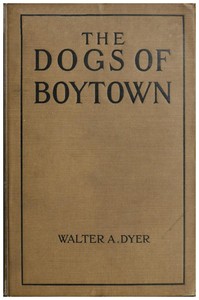
The Dogs of Boytown — Inside the Classic
(0 User reviews)
240
Project Gutenberg
2012
Not confirmed
Dogs -- Juvenile fiction; Conduct of life -- Juvenile fiction; Boys -- Conduct of life -- Juvenile fiction; Families -- Juvenile fiction; Breeding -- Juvenile fiction; Dog shows -- Juvenile fiction
Readers of public-domain and historical texts
Project Gutenberg digital edition
en
Edition facts
Words
71,608
Reading time
312 min
Text sections
8
For The Dogs of Boytown — Inside the Classic, the stored edition analysis reports 71,608 words, 5 hr 12 min estimated reading time, and 8 detected text sections.
The text analysis averages about 16.1 words per sentence, while the detected sections provide another way to judge how the source is divided.
Project Gutenberg metadata also associates the work with “Dogs -- Juvenile fiction,” connecting these edition facts with the source record’s subject description.
Source:
Project Gutenberg record #41444
Walter A. Dyer's 1918 novel follows the boys of a Connecticut town and their dogs, from a stray named Nan to a dog show. The narrative balances affection for boyhood with practical lessons on breeding, training, and humane treatment, using specific breeds and local events to ground the story.
Read the complete public-domain text at its original source.
Read on Project GutenbergThe narrator of The Dogs of Boytown declares early that for “the fullest appreciation of blue skies and autumn woods … give me a boy every time.” This preference sets the tone for a story that treats its young characters—and their dogs—with serious, unsentimental attention. The book opens on a frosty October morning in an unnamed Connecticut town, where Sam Bumpus and his dog Nan are introduced not as symbols but as specific inhabitants of a place the narrator calls Boytown. The author, Walter A. Dyer, wrote several dog stories and here brings a practical knowledge of breeds, kennel life, and dog-show procedure. The excerpts show a world where dogs are working partners, show competitors, and subjects of ethical debate, all filtered through the activities of a boys’ Humane Society.
Boyhood and the Natural World
The narrator’s opening claim—that boys appreciate nature more genuinely than adults—is not merely a nostalgic flourish. It is borne out in the sensory details of the October morning: the frost, the “golden sun,” the “shreds of smoke” from chimneys. The prose lingers on the physical experience of the air, which “was like drinking cold water to take long breaths of it.” This attention to bodily sensation aligns the reader with the boy’s perspective, where the world is felt rather than analyzed. The narrator also admits to having been a boy himself, a framing device that allows for both intimacy and a slight distance. The setting is deliberately generic—Boytown is a pseudonym for a real Connecticut town—but the specificity of the season and the morning light gives the scene a concrete, almost documentary quality. The boys are not idealized; they are simply present, and their enjoyment of the outdoors is presented as a matter of fact, not of rhetoric.
Dogs as Individuals, Not Types
The catalog subjects list “Dogs – Juvenile fiction,” but the excerpts reveal a more nuanced treatment. Dogs are not interchangeable; they have names, breeds, and histories. Nan belongs to Sam Bumpus; Gyp belongs to the disliked Dick Wheaton. When the boys organize a dog show, they debate whether to exclude Gyp because of its owner’s cruelty. Mrs. Hammond advises that “it isn’t Dick that’s going to be benched, but Gyp,” separating the dog’s worth from its owner’s character. The show itself is meticulously planned: benches are built, stalls are whitewashed, and each dog gets a card with its name, breed, and owner. For Rags, a mixed-breed dog, the boys invent a breed name—“wire-haired American terrier”—rather than leave the card blank. This small act shows a respect for the dog’s identity that transcends pedigree. The narrator also notes that the professional kennel owner, Mr. Hartshorn, refuses to enter his own dogs, calling it “highly improper for a judge to have to judge his own dogs.” The book treats dog-show ethics with the same seriousness as the boys’ personal conflicts.
Community, Commerce, and the Dog Show
The Boytown Dog Show is the central event in the excerpts, and it reveals how the community organizes around a shared project. The posters announce 26 dogs of 21 breeds, with admission fees going to the Red Cross—a detail that places the story in a specific historical moment (World War I). The boys handle logistics: Theron Hammond collects fees, Frank Stoddard fills water tins, and the committee builds benches from scavenged boards. The show is not just a competition; it is a civic undertaking that involves adults (Mrs. Hammond, Mr. Hartshorn) and tests the boys’ ability to manage fairness. The decision to admit Gyp despite its owner’s reputation is a moral compromise that prioritizes the dog’s welfare over personal grudges. The excerpts also show a clear hierarchy of expertise: Mr. Hartshorn is the judge, Sam Bumpus is a trainer who “said that a shoemaker had best stick to his last,” and the boys are amateurs learning by doing. The show becomes a microcosm of the town’s values, where dogs are both companions and subjects of serious, rule-bound endeavor.
Readers should note that the excerpts cover only the first half of the book, ending before the show’s judging and the later chapters on trials and the Massatucket Show. The narrative voice is consistent in its affection for both boys and dogs, but it does not shy away from the work involved in caring for animals. The book rewards attention to the specific breeds mentioned—English setter, chow, bulldog, and others—as each appears with its own traits and role in the story. The tension between amateur enthusiasm and professional standards, visible in the show preparations, is likely to persist throughout.
There’s something about that 1918 Connecticut world—boys and their dogs, each learning trust in small, quiet ways—that stayed with me long after I closed it. It made me think of another old favorite, The Young Marooners on the Florida Coast — Inside the Classic, where the wilderness asks the same gentle patience. Both feel less like stories and more like afternoons I once lived.
There are no reviews for this eBook.
There are no comments for this eBook.
Reader reflection
What did you think of this book?
Answer a few questions and save a private reflection on this device.
Your progress
0
/
10
2
What was your overall reaction to the book?
3
Would you pass this book on to a friend?
4
What was the reading difficulty like?
5
How distinctive were its ideas or approach?
6
How useful were the ideas in this book?
7
Was the book what you thought it would be?
8
Was the book easy to understand?
9
Which lesson or insight stayed with you?
10