1

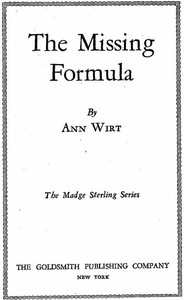
The Missing Formula Madge Sterling Series, #1 — Text and Context
(0 User reviews)
229
Project Gutenberg
2012
Not confirmed
Adventure stories; Vacations -- Juvenile fiction; Canada -- Juvenile fiction; Mystery and detective stories; Thieves -- Juvenile fiction; Scientists -- Juvenile fiction; Women detectives -- Juvenile fiction; Sterling, Madge (Fictitious character) -- Juvenile fiction
Readers of public-domain and historical texts
Project Gutenberg digital edition
en
Edition facts
Words
27,484
Reading time
120 min
Text sections
4
The Missing Formula Madge Sterling Series, #1 — Text and Context can be approached with a clearer sense of reading commitment from its source measurements: 27,484 words, 2 hr estimated reading time, and 4 detected text sections.
The text analysis averages about 12.5 words per sentence, while the detected sections provide another way to judge how the source is divided.
Project Gutenberg metadata also associates the work with “Adventure stories,” connecting these edition facts with the source record’s subject description.
Source:
Project Gutenberg record #40033
Madge Sterling's summer vacation turns into a mystery when she visits reclusive Anne Fairaday on Stewart Island. The narrative moves between lakeside lodges, forest portages, and island cabins, using physical obstacles like storms and darkness to build suspense. Recurring images of water, canoes, and hidden trails frame the search for a missing scientific formula.
Read the complete public-domain text at its original source.
Read on Project GutenbergThe story opens with Madge Sterling standing at a boat landing, gazing across ruffled water toward Stewart Island, which "drowsed like a huge green sea turtle in the heat of a midsummer sun." This image establishes the lake as both a setting and a source of tension: the water separates Madge from the reclusive Anne Fairaday, and the island itself seems to hold secrets. The narrative quickly moves from this static view into action—Madge unties a canoe, is hailed by her uncle, and sets off. The structure relies on a series of departures and arrivals: from lodge to island, from shore to forest, from daylight into darkness. Each transition is marked by a change in pace and a shift in the characters' confidence.
Movement Between Water and Woods
The story's rhythm is built on the contrast between open water and enclosed forest. Madge and Anne paddle across lakes, then carry their canoe over portages—trails that are "a long mile" but taken at a brisk pace. The portage scenes are where the narrative slows down: the girls carry oars and fishing equipment, and the path becomes indistinct. In one key episode, they lose the trail at dusk, and Madge realizes they are lost when "vines and old stumps were always in the way; there seemed no distinct opening through the trees." The forest is a maze of obstacles, while the lake offers a clear horizon. This alternation between visibility and obstruction mirrors the mystery's progress: clues appear and then vanish, and the characters must navigate both physical and informational dead ends.
Recurring Images of Containers and Hidden Places
Several objects in the excerpts function as containers for secrets: a hollow log, a missing book, a secret hiding place. The title itself points to a formula that is absent. The narrative uses these containers to create a pattern of concealment and discovery. For instance, when the girls search for Jack's boat, they find it "under a pile of brush near the water"—hidden in plain sight. Later, a "hollow log" becomes a site of significance. These details are not merely props; they structure the investigation. The characters must learn to look beneath surfaces, whether it's brush, a log, or a book. The repeated motif of hiding and finding gives the story a puzzle-box quality, where each answer leads to another locked compartment.
The Role of Darkness and Disorientation
Darkness is not just a backdrop but an active force in the plot. The first chapter ends with Madge caught in a storm; later, the girls are trapped in the forest after sunset. The text emphasizes sensory deprivation: "It was far darker in the forest than upon the lake. The path was not distinct." Madge relies on instinct rather than sight, and Anne is on the verge of tears. The darkness strips away their confidence and forces them to make decisions without full information. This mirrors the detective work: the formula is missing, and the characters must piece together clues in a kind of intellectual darkness. The physical disorientation—tripping over vines, sinking into muck holes—parallels the mental confusion of the mystery.
Voice and Dialogue as Character Markers
Madge's speech is direct and encouraging, even when she is uncertain. She tells Anne, "We'll get out, only I think we're wasting time trying to find the trail." Her tone balances authority with warmth, as when she calls her aunt "Aunt Maude" and gives her "an affectionate squeeze." In contrast, Anne's dialogue is more hesitant: "I can't go much farther," she half sobs. The exchanges are functional—they move the plot and reveal character without lengthy introspection. The narrator also uses physical description to reinforce voice: Madge's "auburn hair had been whipped carelessly back from her face by the wind," and her uncle's "ruddy cheeks were framed in a healthy tan." These details ground the dialogue in a vivid, outdoor world.
Readers will notice that the story's structure—alternating between open water and closed forest, between daylight and darkness—creates a pattern of tension and release. Pay attention to how objects like the hollow log or the missing book are introduced: they often appear just after a moment of physical exertion or disorientation. The narrative rewards careful observation of setting details, which are never merely decorative but serve as clues to both the mystery and the characters' inner states.
That watery quiet of Madge’s island search reminded me of long afternoons with the old road-trip girls—their engine trouble just another kind of storm, really. Both felt like waiting out weather, not just solving a problem. I remembered my own lakeside summers, reading The Automobile Girls at Chicago; Or, Winning Out Against Heavy Odds — Reading Notes under a pine, the pages smelling of rain. Some puzzles simply ask us to sit still while they unfold.
There are no reviews for this eBook.
There are no comments for this eBook.
Reader reflection
Your personal reading reflection
Build a private reading journal entry for this title.
Your progress
0
/
10
2
Was reading this book enjoyable?
3
Is this a title you would suggest to others?
4
Did the language feel accessible?
5
How clearly were the main ideas presented?
6
How would you rate its originality?
7
Did the book give you something worth debating?
8
How did the pace of the book feel?
9
What did this book teach you most?
10