1

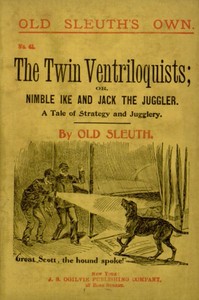
The Twin Ventriloquists; or, Nimble Ike and Jack the Juggler A Tale of Strategy and Jugglery — Reading Companion
(0 User reviews)
464
Project Gutenberg
2013
Not confirmed
Detective and mystery stories; Conduct of life -- Juvenile fiction; Adventure stories; Twins -- Juvenile fiction; Friendship -- Juvenile fiction; Uncles -- Juvenile fiction; Dime novels; Youth -- Conduct of life -- Juvenile fiction; Diligence -- Juvenile fiction; Success -- Juvenile fiction; Charity -- Juvenile fiction; Theft -- Juvenile fiction; Misers -- Juvenile fiction; Ventriloquists -- Juvenile fiction
Readers of public-domain and historical texts
Project Gutenberg digital edition
en
Edition facts
Words
31,067
Reading time
136 min
Text sections
4
This digital edition of The Twin Ventriloquists; or, Nimble Ike and Jack the Juggler A Tale of Strategy and Jugglery — Reading Companion is described by source-level measurements including 31,067 words, 2 hr 16 min estimated reading time, and 4 detected text sections.
The text analysis averages about 14.1 words per sentence, while the detected sections provide another way to judge how the source is divided.
Project Gutenberg metadata also associates the work with “Detective and mystery stories,” connecting these edition facts with the source record’s subject description.
Source:
Project Gutenberg record #43765
Old Sleuth's dime novel follows ventriloquist Nimble Ike and his partner Jack as they use vocal trickery to solve crimes and help the needy. The narrative shifts between rapid-fire dialogue and moralizing asides, with Ike's voice-disguising skills driving both comedy and justice.
Read the complete public-domain text at its original source.
Read on Project GutenbergOld Sleuth opens The Twin Ventriloquists with a burst of exclamation: “Great Cæsar!” The line belongs to Nimble Ike, a ventriloquist whose talent is described as sending “a human voice rambling around through space under the most extraordinary inflectional disguises.” The narrator immediately draws a parallel between detectives, who disguise appearance, and ventriloquists, who disguise voice. This comparison sets up a story in which vocal trickery functions as a tool for justice. Ike, we are told, has “paralyzed professionals and amazed amateurs,” and his gift has been used to “force rogues to confessions.” The opening establishes a fast, confident tone, with the narrator treating Ike’s abilities as both marvelous and morally useful.
Voice as a Narrative Engine
The excerpts show that ventriloquism is not merely a gimmick but the central mechanism of the plot. Ike’s ability to throw his voice allows him to impersonate others, create confusion, and extract confessions. In one scene, he frightens a thief into surrendering stolen bonds by making it seem as though the room itself is speaking. The narrator describes the effect: the thief “just wilted.” The voice becomes a character in its own right, capable of shifting the balance of power. Old Sleuth emphasizes this by contrasting Ike’s vocal skill with the thief’s inability to detect the trick. The narrative voice itself mirrors this flexibility, moving between Ike’s breezy slang (“dead easy”) and the narrator’s more formal moral pronouncements.
Moral Certainty and Pacing
The story alternates between action and explicit moralizing. After recovering the bonds, Ike delivers a lecture: “Crime never pays; criminals always come to a bad end.” The thief is given a second chance, and the narrator endorses this leniency. These didactic passages slow the pace, but they also reinforce the dime-novel convention that adventure serves a moral purpose. The dialogue in these moments is stilted—Ike sounds like a reformer—but the contrast with the earlier, more playful scenes creates a rhythm. The reader moves from the thrill of the ventriloquist’s trick to the satisfaction of justice restored. Old Sleuth uses this alternation to keep the story both exciting and reassuring.
The Hero’s Self-Awareness
Ike is not a naive hero. He knows his own skill and takes pleasure in it. After recovering the bonds, he tells Jack, “I caught my fish easy.” Jack replies with a joke about robbers, and Ike laughs. This self-awareness extends to the narrative: the story is aware it is a story. The chapter titles are long and boastful, promising “astonishing results.” Ike’s confidence borders on arrogance, but the narrator never punishes him for it. Instead, the tale celebrates his cleverness. The young woman who receives her stolen property is overwhelmed; Ike is merely satisfied. This dynamic—the hero’s competence versus the world’s vulnerability—drives the plot forward. The reader is invited to admire Ike’s skill without worrying about consequences.
The excerpts offer only a partial view of the novel, but they reveal a consistent pattern: each chapter introduces a problem that Ike solves through vocal trickery. The moral lessons are delivered with the same confidence as the ventriloquist’s pranks. Readers should pay attention to how Old Sleuth balances the two—when the story speeds up and when it slows down. The pleasure of the book lies in watching a hero who is both clever and righteous, and whose voice can make the world behave.
There’s something tender in how Nimble Ike’s tricks always find their way to kindness, and it reminded me of an old favorite I’d nearly forgotten — The Lady of the Forest: A Story for Girls — Reading Companion. Both feel like wandering into a familiar room, where every voice, hidden or spoken, is just trying to be heard.
There are no reviews for this eBook.
There are no comments for this eBook.
Reader reflection
What did you think of this book?
Answer a few questions and save a private reflection on this device.
Your progress
0
/
10
2
Did this book hold your interest?
3
Is this a title you would suggest to others?
4
Did the language feel accessible?
5
Did the book give you something worth debating?
6
Is this a title worth rereading?
7
Which aspect of the book did you value most?
8
Was the book moving at the right speed?
9
What changed or sharpened your thinking?
10