1

The Motor Boys in Mexico; Or, The Secret of the Buried City — Themes and Context
(0 User reviews)
1306
Project Gutenberg
2013
Not confirmed
Automobiles -- Juvenile fiction; Automobile travel -- Juvenile fiction; Extinct cities -- Juvenile fiction; Mexico -- Juvenile fiction; Brigands and robbers -- Juvenile fiction
Readers of public-domain and historical texts
Project Gutenberg digital edition
en
Edition facts
Words
56,226
Reading time
245 min
Text sections
6
This digital edition of The Motor Boys in Mexico; Or, The Secret of the Buried City — Themes and Context is described by source-level measurements including 56,226 words, 4 hr 5 min estimated reading time, and 6 detected text sections.
The text analysis averages about 13.0 words per sentence, while the detected sections provide another way to judge how the source is divided.
Project Gutenberg metadata also associates the work with “Automobiles -- Juvenile fiction,” connecting these edition facts with the source record’s subject description.
Source:
Project Gutenberg record #43204
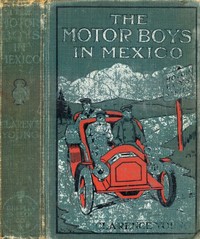
In this third Motor Boys volume, Ned, Bob, and Jerry drive their automobile into Mexico, guided by a professor's map to a buried city. Encounters with jaguars, alligators, and the recurring 'laughing serpent' punctuate a journey shadowed by the scheming Noddy Nixon and the kidnapper Vasco Bilette.
Read the complete public-domain text at its original source.
Read on Project GutenbergA jaguar's attack on a deer carcass, a near-kidnapping foiled by the beast's roar, and a professor who wanders off with only a net and specimen box—these are the incidents that shape the third Motor Boys adventure. Clarence Young's 1906 serial relies less on automotive thrills than on a steady rhythm of campfire alarms and narrow escapes. The boys' automobile, though central to the series premise, often recedes into the background as the party proceeds on foot or by horse, following a dead friend's map toward an underground city. The narrative's energy comes from its episodic structure: each chapter introduces a new threat—animal, human, or environmental—that is resolved before the next begins.
Predators and Prey: The Animal Encounters
The excerpts feature a striking number of animal attacks, each handled with a similar pattern: a sudden appearance, a tense moment, and a quick rifle shot. The jaguar that topples from a tree after Jerry fires three shots is described with 'reddish-green eyes' and a 'long, lithe body'—a predator that nearly succeeds before being dispatched. Later, an alligator catches a monkey, and the 'laughing serpent' is mentioned as a landmark on the map, though its nature remains unexplained in the provided text. These encounters serve a dual purpose: they provide immediate danger and also disrupt the plans of human antagonists. When the jaguar alarms the camp, Vasco Bilette's kidnapping scheme is spoiled, forcing his men to retreat. The animals are not mere decoration; they are active agents that shift the plot's direction.
The Map and the Buried City
The central mystery—the 'secret of the buried city'—is introduced through a professor's map, described as a drawing made by his dead friend. The map includes a highway, a diverging road, and a symbol that might represent the laughing serpent. The party's progress is measured by checking landmarks against this map, yet the excerpts never reveal what the city contains or whether it is reached. The narrative withholds the payoff, focusing instead on the journey: the professor studies the map 'carefully,' the boys keep 'close watch on each foot of the way,' and the search for 'indications' of the underground town becomes a repeated refrain. This deferral builds anticipation, but the reader must finish the book to learn if the map leads to treasure, ruins, or something else entirely.
Rivals and Kidnappers: Noddy Nixon and Vasco Bilette
The human antagonists operate in parallel. Noddy Nixon, a recurring rival from earlier volumes, schemes with Mexicans to thwart the boys, while Vasco Bilette leads a band that attempts to kidnap one of the protagonists. Their methods are indirect: they observe from hiding, withdraw when the camp is alerted, and plan to try again 'to-morrow night.' The jaguar's intervention forces them to retreat, but they remain a persistent threat. Notably, the villains are not fully developed; they are defined by their actions—plotting, growling, and retreating. The narrative treats them as obstacles to be outmaneuvered rather than characters to be understood. This aligns with the serial's formula: each volume introduces a new scheme for the same antagonists, ensuring continuity without requiring deep characterization.
Readers approaching this volume should expect a series of self-contained episodes rather than a tightly woven plot. The automobile, despite the series title, is less a focus than the wilderness setting and the constant threat of ambush—both animal and human. The buried city remains a distant goal, and the map's secrets are parceled out slowly. For those following the Motor Boys series, this installment continues the rivalry with Noddy Nixon while introducing the Mexican landscape as a backdrop for adventure. The book rewards attention to small details: the professor's absent-mindedness, the monkeys' chattering as an alarm system, and the way a single jaguar can change the course of a kidnapping.
Reading about Ned, Bob, and Jerry chasing that buried city through Mexican dust, I remembered sitting under a porch light with The Missing Formula Madge Sterling Series, #1 — Text and Context, where a missing clue felt just as heavy as their jaguar shadows. Both books carried that quiet ache of figuring things out alone—not thrill, exactly, but a patient hope that the map leads somewhere true.
There are no reviews for this eBook.
There are no comments for this eBook.
Reader reflection
How did this book work for you?
Your answers remain private and are stored only in this browser.
Your progress
0
/
10
2
Did this book hold your interest?
3
Would you recommend this book to another reader?
4
What was the reading difficulty like?
5
Is this a title worth rereading?
6
How closely did the book connect with your experience?
7
Could you apply anything you learned?
8
How distinctive were its ideas or approach?
9
What changed or sharpened your thinking?
10