1

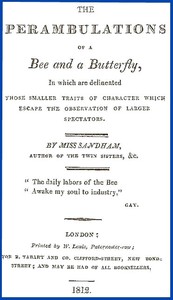
The Perambulations of a Bee and a Butterfly, In which are delineated those smaller traits of character which escape the observation of larger spectators. — Inside the Classic
(0 User reviews)
503
Project Gutenberg
2013
Not confirmed
Conduct of life -- Juvenile fiction; Children -- Conduct of life -- Juvenile fiction; Natural history -- Juvenile fiction; Butterflies -- Juvenile fiction; Bees -- Juvenile fiction
Readers of public-domain and historical texts
Project Gutenberg digital edition
en
Edition facts
Words
22,756
Reading time
99 min
Text sections
3
The Perambulations of a Bee and a Butterfly, In which are delineated those smaller traits of character which escape the observation of larger spectators. — Inside the Classic can be approached with a clearer sense of reading commitment from its source measurements: 22,756 words, 1 hr 39 min estimated reading time, and 3 detected text sections.
The text analysis averages about 38.4 words per sentence, while the detected sections provide another way to judge how the source is divided.
Project Gutenberg metadata also associates the work with “Conduct of life -- Juvenile fiction,” connecting these edition facts with the source record’s subject description.
Source:
Project Gutenberg record #43270
Elizabeth Sandham's 1812 children's novel uses the conversations of a bee and a butterfly to expose vanity and industry, with precise observations on human behavior drawn from natural history.
Read the complete public-domain text at its original source.
Read on Project GutenbergElizabeth Sandham's The Perambulations of a Bee and a Butterfly (1812) opens with a young bee leaving the hive against his mother's advice, a decision that leads to suffering and confinement. The narrative quickly establishes a pattern: each chapter pairs the insect protagonists' adventures with pointed commentary on human foibles. Sandham's subtitle promises to delineate 'those smaller traits of character which escape the observation of larger spectators,' and she delivers through the bee's industrious perspective and the butterfly's vanity.
The excerpts reveal a work structured around dialogue and moral contrast. The bee values useful employment and maternal approval, while the butterfly prioritizes pleasure and appearance. Their exchanges allow Sandham to critique social pretensions without direct moralizing, using the natural world as a mirror for human conduct.
Dialogue as a Vehicle for Moral Contrast
Sandham builds her moral lessons through extended conversations between the bee and the butterfly. In one passage, the butterfly recounts seeing a boy who 'has got a new coat just brought home from the taylor's' and refuses to go out because the weather is lowering, sitting alone in his room 'with the coat on, though there is no one but himself to admire it.' The bee, in response, reflects that he has 'heard such instances of vanity in a race so superior' that he can now forgive it in a butterfly. This technique—using the insects' observations to mirror human behavior—allows Sandham to critique vanity indirectly. The butterfly's own preoccupation with his wings' colors after a rain shower reinforces the point: he asks another butterfly 'if their colours had received any injury,' a question the bee overhears and interprets as further evidence of superficiality.
The Bee's Industrious Ethos and Its Limits
The bee consistently defines pleasure as useful activity. When the butterfly invites him to 'enjoy a little pleasure' on an afternoon flight, the bee replies: 'my enjoyment is to be usefully employed, and to receive my mother's approbation; but as I know this is a pleasure you cannot understand, I would not wish to deprive you of what you can enjoy.' This exchange encapsulates the book's central tension between industry and idleness. However, Sandham does not simply endorse the bee's viewpoint; she allows the butterfly to depart 'with this encouragement, yet not able to comprehend why all creatures did not find a pleasure in the same thing.' The narrator adds that 'to the eye of reason such a distinction of enjoyments in the various objects of creation, is an evident token of the Wisdom with which they are formed,' suggesting a providential design that accommodates different natures.
Mistaken Identity and the Limits of Perception
A notable episode involves the butterfly mistaking a Bee-Orchis for his friend. The butterfly insists he saw the bee 'almost buried in the heart of a flower' and 'so intent upon your labour, that you would not even answer me when I called.' The bee corrects him: 'you have seen a Bee-Orchis, as they are called, a flower which bears both the form and resemblance of our species.' This moment of mistaken identity serves multiple purposes. It demonstrates the butterfly's tendency to jump to conclusions based on appearances, a flaw Sandham associates with vanity. It also introduces a piece of natural history—the bee orchid's mimicry—which aligns with the book's catalog subject of natural history. The episode subtly warns readers against trusting superficial resemblance, a theme that recurs in the butterfly's later encounters with flattery and deception.
Social Satire Through Insect Eyes
Sandham extends her critique beyond individual vanity to social hierarchies. The butterfly observes a 'poor woman, who has, perhaps, been working hard to make them what they are, stands trembling before him, as if she had committed the greatest trespass in the world.' This glimpse of class dynamics is rare in the excerpts but significant. The butterfly's commentary on 'the vanity of the sex' and his surprise that 'men and boys were above such vanity' suggests Sandham uses the insect characters to question gender norms. The bee, meanwhile, remains focused on his work, gathering honey and forming cells. Their differing responses to the same scenes—the butterfly noticing dress and appearance, the bee noting industry and utility—create a layered social observation. The excerpts do not reveal whether these threads are sustained, but they indicate a work that uses its fantastical premise to examine real-world behaviors.
Readers approaching The Perambulations of a Bee and a Butterfly should attend to the interplay between the two protagonists' voices. Sandham's dialogue-driven narrative rewards close attention to how each character's language reveals their values. The bee's measured, principled speech contrasts with the butterfly's more excitable, appearance-focused remarks. The book's structure—each chapter a new adventure—makes it suitable for episodic reading, while the moral observations invite reflection on the 'smaller traits of character' that the subtitle promises to expose.
Reading about the bee’s patient, methodical work reminded me of my father, who kept a journal of every garden bloom. I found the same tender attention in The Perambulations of a Bee and a Butterfly, and it nudged me back to a childhood summer with The Radio Detectives in the Jungle — Inside the Classic, where small sounds and quiet footsteps mattered just as much as any grand adventure.
There are no reviews for this eBook.
There are no comments for this eBook.
Reader reflection
Your personal reading reflection
Build a private reading journal entry for this title.
Your progress
0
/
10
2
What was your overall reaction to the book?
3
How likely are you to recommend this book?
4
What was the reading difficulty like?
5
Was the book easy to understand?
6
What was the strongest part of the book?
7
Did the story or argument move comfortably?
8
How distinctive were its ideas or approach?
9
What changed or sharpened your thinking?
10